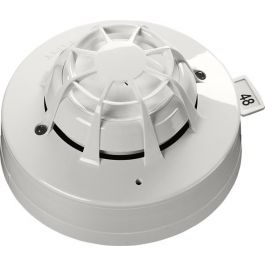

Apollo XP95 A2S Heat Detector - 55000-400

The XP95 range of analogue addressable fire detectors uses tried and trusted technology to give the best performance, and has unique features that benefit the installer and the end user. It is suitable for medium-to-large applications with simple installation requirements. As it operates using digital communication, XP95 has a high immunity from corruption, and is, therefore, often preferred in a large system where life safety is critical. XP95 products are frequently used in commercial, industrial, financial, government, IT/telecoms and healthcare applications.
In stock
SKU
55000-400
£20.87
£25.04
Brand Information
The XP95 range of analogue addressable fire detectors uses tried and trusted technology to give the best performance, and has unique features that benefit the installer and the end user. It is suitable for medium-to-large applications with simple installation requirements. As it operates using digital communication, XP95 has a high immunity from corruption, and is, therefore, often preferred in a large system where life safety is critical. XP95 products are frequently used in commercial, industrial, financial, government, IT/telecoms and healthcare applications.
Electrical Description
The detectors are designed to be connected to a two wire loop circuit carrying both data and a 17V to 28V dc supply. The detectors are connected to the incoming and outgoing supply via terminals L1 and L2 in the mounting base. A remote LED indicator requiring not more than 4mA at 5V may be connected between +R and -R terminals. An earth connection terminal is also provided. When a device is energised the ASIC regulates the flow of power and controls the data processing. The thermistor provides an output over normal operating ranges that is proportional to the external air temperature. This voltage output is processed in the A/D converter and stored by the communications ASIC. It is transmitted to control equipment when the device is interrogated. When a count of 55 is exceeded the alarm flag is initiated and the device address is added to the data stream every 32 polling
Operation
The XP95 heat detectors have a common profile with ionisation and optical smoke detectors but have a low air flow resistance case made of self-extinguishing white polycarbonate. The devices monitor heat by using a single thermistor network which provides a voltage output proportional to the external air temperature. The standard heat detectors, 55000-400 and 55000-420, respond to increasing air temperature in such a way that they are classified as an A2S device. Both devices will give 55 counts at 55°C. A high temperature CS heat detector, 55000-401, which can be installed in a typical ambient temperature of 55°C is available. This device will give 55 counts at 90°C.
Application
The choice of detector from the XP95 range follows the well established principles of system design. That is, the optimum detector type will depend on the type of fire risk and fire load, and the type of environment in which the detector is sited. For general use, smoke detectors are recommended since these give the highest level of protection. Smoke detectors from the XP95 range may be ionisation, optical or multisensor types. It is generally accepted that ionisation types have a high sensitivity to flaming fires whereas optical detectors have high sensitivity to smouldering fires. As a result of this, ionisation types are widely used for property protection, and optical types for life protection. These general principles still apply to XP95 detectors although the availability of a multisensor in the range offers more choice to the system designer. The multisensor is basically an optical smoke detector and will therefore respond well to the smoke from smouldering fires. The detector also senses air temperature. This temperature sensitivity allows the multisensor to give a response to fast burning (flaming) fires, which is similar to that of an ionisation detector. The multisensor can therefore be used as an alternative to an ionisation detector - particularly since restrictions on the transportation of ionisation detectors have been introduced. Where the environment is smoky or dirty under normal conditions, a heat detector may be more appropriate. It must be recognised, however, that any heat detector will respond only when the fire is well stablished and generating a high heat output. Unless otherwise specified, devices described in this guide are suitable for indoor use only.
Device Addressing
The XP95 detectors provide an alarm facility that automatically puts an alarm flag on the data stream and reports its address when the pre-set EN54 thresholds are exceeded. The devices provide great flexibility in system design with the control equipment determining the characteristics of the system. A large and growing range of compatible control equipment is available from many sources - details are included in Apollo publication PP1010, which is available on request.
Communication
Apollo XP95
Backward Compatibility
The device is compatible with Series 90, Discovery® and XPlorer systems.
Maintenance & Service
Detectors should be maintained according to BS 5839-1 or other locally applicable code. Test equipment can be ordered from Apollo for testing smoke and heat detectors. Detectors should not be cleaned in the field except for careful removal of exterior dirt with a damp cloth. For cleaning and recalibration detectors should be returned to Apollo Fire Detectors or to the local distributor.
EMC Directive 2014/30/EU
The XP95 Heat Detector complies with the essential requirements of the EMC Directive 2014/30/EU, provided that it is used as described. A copy of the Declaration of Conformity is available from Apollo upon request. Conformity of the XP95 Heat Detector with the EMC Directive, does not confer compliance with the directive on any apparatus or systems connected to it.
Construction products regulation 305/2011
The XP95 Heat Detector complies with the essential requirements of the Construction Products Regulation 305/2011/EU. A copy of the Declaration of Performance is available from Apollo upon request.
Environmental Characteristics
XP95 Standard Heat Detectors operate over the range -20°C to +70°C, the High Temperature Heat Detectors operate over the range –20°C to +120°C. The detectors are unaffected by atmospheric pressure.
Product Information
The XP95 Heat Detector monitors temperature by using a single thermistor which provides a count output proportional to the external air temperature. The XP95 range features two heat detectors, standard and high temperature. The standard heat detector is classified as an A2S device and will report an alarm at 55°C. The high temperature detector, classified as a CS device, will report an alarm at 90°C.
Key Features
Ideal in environments that are dirty or smoky under normal conditions Well-suited to warehouses, loading bays and car parks Unaffected by wind or atmospheric pressure
Attachments
Related Products